
Your healthy spine and fresh mind is always our priority!
Why Sitting is Damaging Your Spine More Than You Think
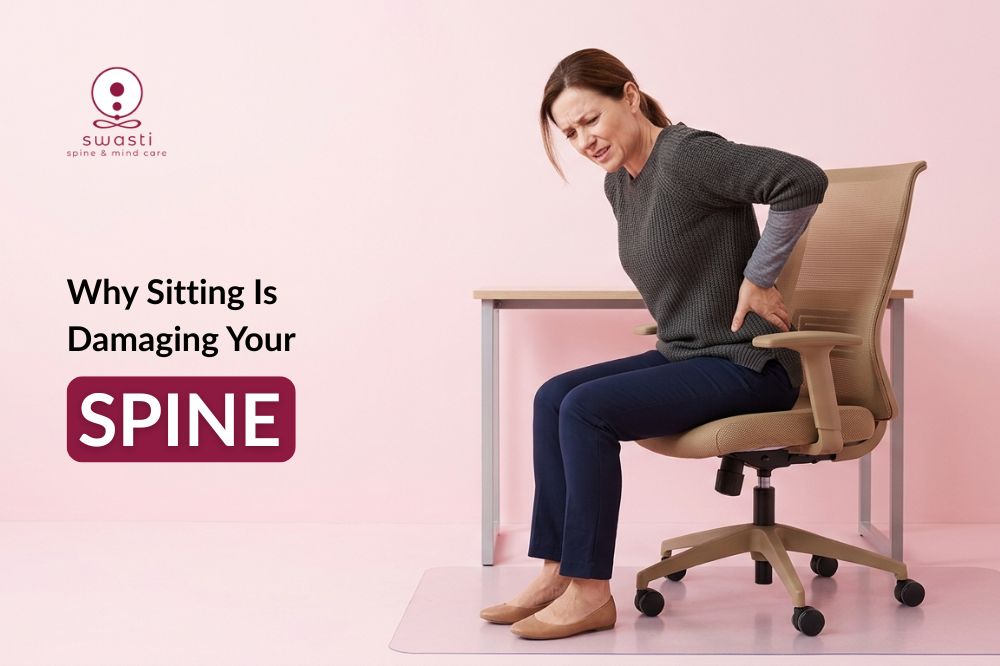
You probably already know that sitting for too long isn’t good for you. But most people imagine the worst that can happen is a bit of back soreness that goes away after a walk. The reality is quite different, and far more gradual.
The human spine was never designed to hold one position for hours at a stretch. Yet most working adults in India spend anywhere from 8 to 12 hours a day seated: at a desk, in traffic, at the dinner table, and then on the couch. That’s not just uncomfortable. Over time, it creates real, measurable damage to the structures that hold your spine together.
This article explains what actually happens inside your spine when you sit for too long, how to recognise the early warning signs, and most importantly, what you can do about it before the problem becomes serious.
What Actually Happens to Your Spine When You Sit
Your spine is made up of 33 vertebrae stacked on top of each other, separated by rubbery discs filled with a gel-like centre. This design allows you to bend, twist, and absorb the shocks of daily movement. It is built for motion, not for hours in a chair.
Here’s what prolonged sitting does to that system:
1. It Compresses Your Spinal Discs
When you’re standing or walking, the pressure on your lumbar (lower back) discs is distributed fairly evenly. The moment you sit, especially if you slouch, that pressure shifts dramatically forward onto the front portion of the discs.
Research in spine biomechanics has shown that disc pressure while sitting in a slouched position is significantly higher than when standing upright. When this load is sustained day after day for years, the discs lose hydration and height through a process called disc degeneration. This is one of the leading causes of chronic lower back pain in working-age adults, and in more advanced cases, it can lead to a herniated or slipped disc.
If you’ve been wondering whether your back pain is coming from a disc issue or a muscle problem, our detailed guide on slip disc vs. muscle strain can help you understand the difference.
2. Your Core and Stabilising Muscles Switch Off
Sitting, especially in a supported chair, essentially puts your core and gluteal muscles on autopilot. Because the chair is doing the work of holding you upright, the muscles that are supposed to do that job stop firing effectively. Over weeks and months, they become weak and underactive.
This matters because those same muscles are your spine’s natural shock absorbers and stability system. A weak core means your spine has to bear loads it wasn’t meant to manage alone. The result is not just pain. It is a spine that becomes progressively more vulnerable to injury even from routine activities like bending to pick something up.
3. Your Hip Flexors Shorten and Pull Your Pelvis Out of Alignment
When you sit with your hips at a 90-degree angle for hours, the hip flexor muscles, particularly the iliopsoas, remain in a shortened position. Over time, they adapt to that shortened state and lose their ability to fully lengthen.
Tight hip flexors tug the front of the pelvis downward, creating an exaggerated forward curve in the lower back (hyperlordosis). This misalignment puts uneven stress on the lumbar vertebrae and the discs between them, often causing a persistent, dull ache in the lower back that many people dismiss as “normal.”
4. Forward Head Posture Strains Your Neck and Upper Back
Every time you lean toward a screen, whether it is a monitor, laptop, or phone, your head moves forward of its natural position over your shoulders. For every inch your head moves forward, the effective weight your cervical spine (neck) must support nearly doubles.
The average human head weighs between 4.5 to 5.5 kg. In a neutral position, your cervical spine handles that load with relative ease. But a forward head posture of just 5 cm can increase the load on your neck muscles and joints to the equivalent of 18 to 22 kg. Hold that position for 6 to 8 hours a day, and it’s no surprise that neck stiffness, tension headaches, and upper back pain become everyday experiences.
5. Reduced Blood Flow to Spinal Structures
Spinal discs don’t have their own blood supply. They rely on movement, specifically the gentle compression and decompression of daily activity, to absorb nutrients from surrounding tissue. When you stay still for hours, this exchange slows significantly. Discs become less nourished and more prone to wear and tear over time.
Warning Signs You Shouldn’t Ignore
Most sitting-related spine damage develops quietly over months and years. But there are early signals your body sends that deserve attention:
- Back or neck pain that worsens toward the end of the workday but feels better after a night’s rest
- Morning stiffness in the lower back or neck that takes 15 to 30 minutes to ease
- A nagging ache after standing up from your chair, especially if you have been sitting for more than an hour
- Tingling, numbness, or a pins-and-needles sensation in your arms or legs (this can indicate nerve involvement and should be evaluated promptly)
- Rounded shoulders that feel difficult to correct even when you consciously try
- An awareness that you’re frequently shifting in your seat, stretching, or cracking your back to find relief
These early signs are your spine’s way of asking for help, not symptoms to push through.
Why Office Workers Face a Compounded Risk
It’s not just the sitting itself. The typical office environment stacks multiple risk factors together:
Uninterrupted sitting: Unlike a waiter who sits and stands throughout a shift, desk workers can remain seated for 2 to 3 hours without getting up.
Poor workstation setup: Monitors placed too low or too high, chairs without lumbar support, and keyboards at incorrect heights all force the spine into compensatory positions.
Laptop use: Laptops are particularly problematic because the screen is inevitably below eye level. You either bend your neck to look at the screen or hunch your back to bring your eyes closer to it, and neither option is good for your spine.
Mental stress: Job stress causes muscle tension, particularly in the shoulders, upper trapezius, and neck. Chronic tension in these areas compounds the mechanical load already placed on the spine by poor posture.
The “I exercise so I’m fine” assumption: An hour at the gym does not undo ten hours of sitting. Cardiovascular fitness and disc health are different things. You can be physically active and still have a sedentary spine.
Practical Steps That Actually Help
The good news is that this damage is largely preventable, and in its early stages, reversible. The changes required aren’t dramatic.
Break the sitting pattern, not the job
The single most effective intervention is interrupting prolonged sitting. Set a reminder to stand up, take a short walk, or do a couple of minutes of gentle movement every 30 minutes. This isn’t about taking a break from work. It is about keeping the tissues of your spine alive and nourished throughout the day.
Sit with your spine in mind
What does good sitting posture actually look like? Your ears should sit directly over your shoulders, not forward of them. Your shoulders should be relaxed, not hunched. Your lower back should have a gentle inward curve, not flattened against the chair back or exaggerated forward. Your feet should rest flat on the floor with your knees at roughly hip height.
If your chair doesn’t support a neutral lower back position, a small rolled towel or lumbar cushion placed at the curve of your lower back can make a meaningful difference.
Get your screen height right
The top of your monitor should be at or very slightly below eye level, at arm’s length from your face. If you use a laptop as your primary work device, consider a separate keyboard and mouse so you can raise the screen to a proper height.
Build the muscles your spine depends on
Sitting weakens the core, glutes, and upper back muscles that support your spine. Targeted strengthening of these areas, even with basic exercises done at home, can significantly reduce spine-related pain and injury risk. Exercises worth incorporating include glute bridges, planks, bird-dogs, and thoracic extension stretches. For the neck and upper back, chin tucks and scapular retractions are particularly helpful for counteracting the forward head posture that screens create.
Walk Every Day, Not Just for Fitness but for Your Discs
A 20 to 30 minute walk at a comfortable pace does more for your spinal health than most people realise. Walking creates the rhythmic compression-decompression cycle that nourishes your discs and helps redistribute fluids that accumulate in disc tissue during long periods of static sitting.
A Note on When Symptoms Become Serious
Most people ignore back and neck pain until it becomes disabling. That’s understandable because life is busy. But the threshold for getting a professional opinion should be lower than most people set it.
Consider seeing a spine specialist if:
- Your back or neck pain has persisted for more than 3 to 4 weeks despite rest and basic care
- You’re experiencing radiating pain, numbness, or weakness that travels into your arm or leg
- Your symptoms are worsening over time rather than staying stable
- Pain is disrupting your sleep or making it difficult to perform your job or daily activities
In cases where disc damage has progressed, a spine specialist can assess whether your condition can be managed with physiotherapy and rehabilitation, or whether more targeted intervention is needed. When disc problems do become severe, it’s worth understanding when a slipped disc requires surgery so that you are informed before a consultation rather than surprised during one.
And for those who do require surgical intervention, it’s reassuring to know that modern approaches have advanced significantly. Many conditions that once required extensive open surgery can now be addressed through minimally invasive spine surgery techniques that offer faster recovery and less disruption to the surrounding tissue.
Conclusion
If your desk-job lifestyle has been taking a toll on your back and neck, you don’t have to wait until the pain becomes unbearable to seek help. At Swasti Spine and Mind Care, we work with patients who are dealing with sitting-related back pain, posture problems, disc issues, and sciatica. We support those in the early stages who want to prevent things from getting worse, as well as those who need structured rehabilitation or advanced treatment.
Our team includes a dedicated spine specialist who understands the specific challenges that prolonged sitting creates for working adults, and works with patients to develop practical, personalised plans that fit real lives.
As the leading spine hospital in Ahmedabad, Swasti Spine & Mind Care is equipped to handle everything from posture assessment and physiotherapy to advanced spine care, so that wherever you are in your spine health journey, you are in the right hands.
Frequently Asked Questions
I sit for about 8 hours a day at work. How quickly can this start causing spine problems?
There’s no single timeline because it depends on your posture, workstation setup, and how much movement you get outside of work. However, research suggests that even a few weeks of sustained poor sitting posture can lead to measurable changes in muscle activation patterns and early disc stress. The pain may take months or years to appear, but the physiological changes begin much earlier, which is why building good habits early matters.
My back hurts only at the end of the day and goes away overnight. Should I still be concerned?
Pain that appears late in the day and resolves with rest is actually a classic early warning sign, not a sign that things are fine. It typically means your spinal structures are being stressed during the day but have enough recovery time overnight to reduce inflammation. If you don’t address the underlying cause, the rest periods gradually stop being enough, and the pain starts staying with you longer.
I’ve started going to the gym. Does that protect my spine from the effects of sitting?
Regular exercise is genuinely helpful. It strengthens the muscles that support your spine, improves blood flow, and maintains flexibility. But exercise and sitting are separate variables. Studies have consistently shown that even people who meet recommended physical activity guidelines can experience sitting-related health consequences if they spend the majority of their day sedentary. Think of it as: exercise is essential, but it doesn’t cancel out prolonged sitting. You need both: more movement throughout the day and intentional exercise.
What’s the difference between a chair that’s “ergonomic” and one that’s actually good for my spine?
An ergonomic chair is designed to support your spine’s natural curves, but a chair alone doesn’t fix poor sitting habits. The most important factors are: adjustable seat height (so your feet rest flat on the floor), lumbar support at the right position for your back, and seat depth that doesn’t press behind your knees. Even the best chair can cause problems if you sit in it for 4 hours without moving. Chair quality matters, but posture and movement breaks matter more.
I’ve had lower back pain for about two months and it’s starting to shoot down my leg. Is this serious?
Pain that radiates from the lower back into the leg, particularly if it follows a line down the back of the leg, can indicate nerve irritation or compression, often associated with a disc problem. This is not something to manage on your own with stretching alone. You should consult a spine specialist for a proper evaluation, which may include imaging, to understand what’s happening and get appropriate treatment.
Can children and teenagers develop sitting-related spine issues too?
Yes, and this is an increasingly recognised concern. With online schooling, gaming, and heavy smartphone use, children and adolescents are now spending more time in prolonged seated positions than previous generations. The spine is still developing during these years, making it particularly sensitive to sustained poor posture. Encouraging regular movement breaks, limiting screen time, and ensuring proper desk setup at home are all important for young people’s long-term spine health.