
Your healthy spine and fresh mind is always our priority!
Slip Disc vs Muscle Strain: How to Identify the Real Cause of Your Back Pain
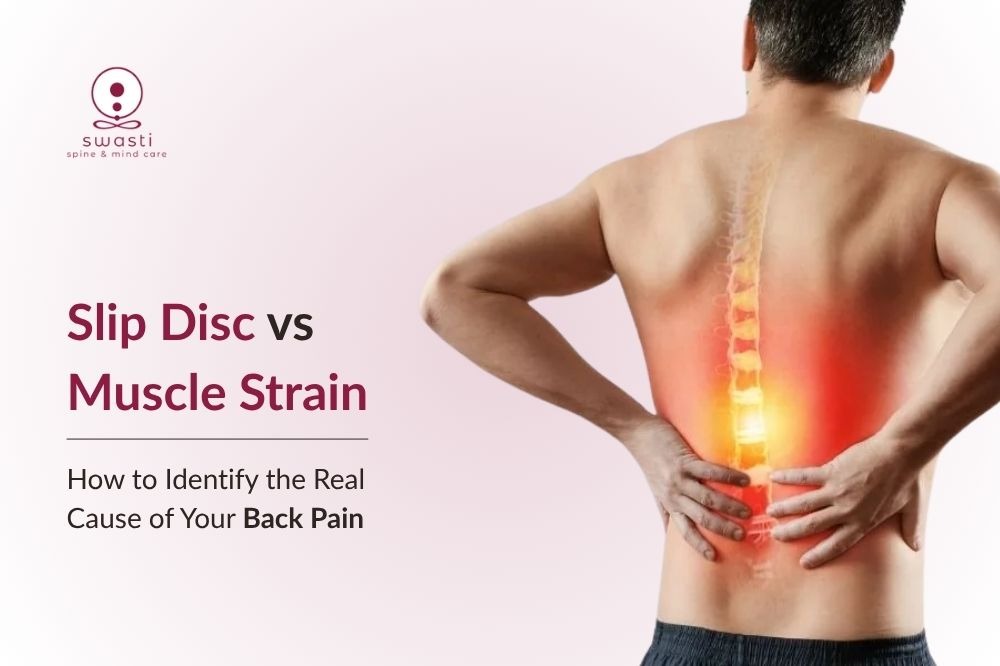
Back pain is one of the most frustrating experiences, especially when you don’t know what’s actually causing it. Are you dealing with a simple muscle strain that’ll heal on its own, or could it be something like a slip disc? This question matters more than most people realise, because the two conditions are fundamentally different and require very different treatment approaches.
Let’s break it down in plain language so you can make sense of what your body is telling you.
What Is a Muscle Strain?
A muscle strain happens when the muscles or ligaments supporting your spine are overstretched or overworked. Think of it as your back’s support system being pushed past its limit, whether from lifting something heavy with poor form, a sudden awkward twist, or simply sitting at a desk for too long with bad posture.
Typical Symptoms Include:
- Pain that stays in your lower back-it doesn’t travel down your leg
- A dull, aching, or tight sensation rather than sharp or electric pain
- Stiffness or muscle spasms that ease with rest
- No numbness, tingling, or weakness in the legs
The good news? Most muscle strains improve significantly within 1-3 weeks with appropriate rest and gentle movement.
What Is a Slip Disc?
A slip disc-medically known as a herniated or prolapsed disc, is a more complex condition. Each disc in your spine acts like a cushion between vertebrae. When the soft inner material of a disc pushes through a weak spot in its outer layer, it can press on a nearby nerve, and that’s when things get more serious.
Key Symptoms to Watch for:
- Pain that travels from your back down through your buttock, thigh, and calf (commonly called sciatica)
- Sharp, burning, or electric shock-like sensations-not just a dull ache
- Numbness or tingling in specific areas of your leg or foot
- Possible weakness in your leg or difficulty walking normally
The key distinction: a slip disc causes nerve-related symptoms, not just localised back pain. If your pain extends below the knee, that’s a strong signal that a nerve is involved.
Quick Comparison at a Glance
| Feature | Muscle Strain | Slip Disc |
| Pain Location | Stays in lower back | Radiates to buttock & leg |
| Pain Type | Dull, aching, tight | Sharp, burning, electric |
| Numbness / Tingling | Absent | Often present in leg/foot |
| Aggravating Factors | Movement, activity | Sitting, bending, coughing |
| Typical Recovery | 1-3 weeks | Weeks to months |
Red Flag Symptoms-Don’t Wait on These
Certain symptoms need immediate medical attention. Seek care from a spine specialist right away if you notice:
- Pain radiating down your leg that’s progressively worsening
- Growing weakness in your leg or foot
- Numbness in the groin or saddle area
- Loss of bladder or bowel control
Common Myths-Quickly Busted
Myth: Severe pain always means a slip disc. Not true. Muscle strains can be extremely painful. What matters is the pattern and type of pain, not just how intense it feels.
Myth: Every slip disc needs surgery. Research consistently shows that 80-90% of slip disc cases resolve with proper conservative treatment-physiotherapy, medication, and lifestyle changes. So, when does a slipped disc require surgery? Surgery is reserved for very specific situations.
Myth: You always need an MRI. A skilled spine specialist can often make an accurate diagnosis from symptoms and a physical exam alone. MRI is recommended only when it will actually change the treatment plan.
Treatment: What Actually Works
For muscle strains, recovery is usually straightforward-stay gently active (prolonged bed rest actually slows healing), apply heat to relax the muscles, and consider physiotherapy to correct posture and prevent recurrence. Most people are back to normal within a few weeks.
For slip disc treatment is more involved but still primarily non-surgical. A guided programme of specialised physiotherapy, appropriate pain management, and lifestyle modifications helps the vast majority of patients avoid surgery. Surgical intervention is only considered when conservative treatment hasn’t worked after 6-12 weeks, or when there are signs of progressive neurological decline.
When Should You See a Spine Specialist?
Don’t wait if you’re experiencing:
- Back pain lasting more than 2-3 weeks without improvement
- Pain radiating into your leg, especially below the knee
- Numbness, tingling, or weakness in your legs or feet
- Difficulty carrying out your normal daily activities
The Bottom Line
Back pain doesn’t have to be a mystery. Here’s the simple rule to carry with you: pain that stays in your back usually points to muscle strain, while pain that travels down your leg suggests nerve involvement-likely a slip disc.
Getting the right diagnosis from the start saves you time, unnecessary anxiety, and treatments that won’t actually help. At Swasti Spine and Mind Care, our approach is built on accurate clinical evaluation, evidence-based care, and a conservative-first philosophy, because most back problems don’t need surgery, they need the right care.